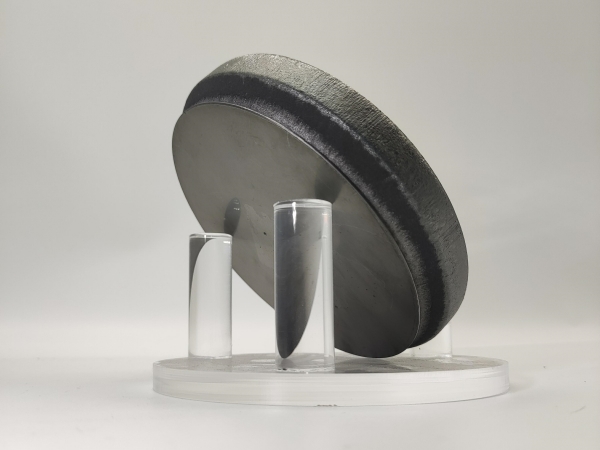
Under high temperature and high purity environments, the selection boundary between BF33 (borosilicate glass) and quartz glass is mainly determined by temperature threshold and purity requirements, supplemented by thermal expansion matching, chemical stability and cost control. The core conclusion can be summarized as follows: when the temperature is >500℃ or ultra-high purity (metal impurities <1ppm) is required, quartz glass must be selected; when the temperature is ≤450℃, medium-high purity is required, matching with silicon is needed, and cost control is necessary, BF33 is preferred. The boundary is detailed below from three aspects: core performance, working condition matching and typical scenarios.

I. Core Performance Boundaries (Core Basis for Selection)
1. Heat Resistance Temperature Boundary (Most Critical Selection Index)
Heat resistance temperature is the primary dividing line for the selection of the two, directly determining the applicability of working conditions. The specific parameters are as follows:
- • BF33 (Borosilicate Glass): The long-term safe service temperature is ≤450℃, and the short-term limit service temperature does not exceed 500℃ (with a duration of <10h), and its softening point is about 820℃. If used for a long time above 450℃, problems such as boron and alkali metal precipitation, material deformation and air tightness failure will occur, which cannot meet the stability requirements of high-temperature working conditions.
- • Quartz Glass (Fused Silica): The long-term service temperature can reach 1000–1100℃, the short-term limit temperature can reach 1200–1400℃, and the softening point is about 1650–1700℃. Its core advantage is that it can still maintain low impurity precipitation and high dimensional stability in high-temperature environments above 1000℃ without deformation or performance degradation.
Boundary Summary: 450℃ is the core dividing point of the heat resistance temperature of the two. For working conditions above 500℃,
BF33 is completely unavailable, and
quartz glass must be selected; for medium-temperature working conditions ≤450℃,
BF33 can meet the basic heat resistance requirements.
2. Purity and Impurity Precipitation Boundary (Core Requirement for High Purity Environment)
In high-purity environments, the impurity content of materials and their high-temperature precipitation characteristics directly affect the safety of working conditions and product purity. The differences between the two are significant:
- • BF33: Its main components are SiO₂≈81%, B₂O₃≈13%, and it also contains about 4–5% of impurities such as Na₂O and Al₂O₃, among which the content of alkali metals (Na/K) is about 100–500ppm, and the content of Al is about 200ppm. When the temperature is >400℃, ions such as Na⁺ and B³⁺ will start to precipitate, which is easy to contaminate the high-purity atmosphere, wafers or reaction system. It is only suitable for medium-high purity (impurities <500ppm), non-trace analysis and non-ion sensitive scenarios.
- • Quartz Glass: The SiO₂ content of high-purity quartz glass is ≥99.99%, and that of ultra-high purity grade can reach more than 99.999%. The content of metal ion impurities is <1ppm, and it contains almost no alkali metals. Even at high temperatures above 1000℃, the amount of impurity precipitation is still extremely low, which is fully suitable for scenarios with high purity requirements such as semiconductors, epitaxial growth and high-purity reagent preparation.
Boundary Summary: For high-purity (impurities <10ppm) or ultra-high purity (impurities <1ppm) environments,
quartz glass must be selected; for medium-high purity and non-ion sensitive scenarios,
BF33 can be selected.
3. Thermal Expansion and Thermal Shock Boundary (Adaptation to High-Temperature Cycle/Bonding Scenarios)
When the working conditions involve high-temperature cycles and silicon-based bonding, the matching of thermal expansion coefficient (CTE) and thermal shock performance become supplementary basis for selection:
- • BF33: The CTE is about 3.25×10⁻⁶/K (20–300℃), which is highly matched with silicon materials (CTE 3.2–3.4ppm/℃). During the silicon-glass bonding process, the stress is small, and warpage and cracking are not easy to occur; the thermal shock temperature difference is about 300℃, which can meet the temperature fluctuation requirements in the medium-temperature range.
- • Quartz Glass: The CTE is about 0.55×10⁻⁶/K, which has an extremely low thermal expansion coefficient, but the CTE mismatch with silicon materials is large. During high-temperature bonding, stress concentration is likely to occur, leading to warpage and cracking; the thermal shock temperature difference is >1000℃, which can adapt to extreme working conditions with ultra-high temperature fluctuations.
Boundary Summary: For scenarios involving silicon-based bonding and medium-temperature cycles (≤450℃),
BF33 is preferred; for scenarios involving ultra-high temperature thermal shock (>500℃) and no silicon-based bonding requirements,
quartz glass is selected.
4. Chemical Stability Boundary (Adaptation to Corrosive/Special Atmospheres)
Chemical atmospheres (acids, alkalis, halogens, etc.) in high-temperature environments will affect the service life of materials, and the chemical stability differences between the two are clear:
- • BF33: It can only resist weak acid and neutral atmospheres. When the temperature is >400℃, strong alkalis and halogens (Cl/F) will accelerate the erosion of materials, and B₂O₃ is easy to volatilize, leading to material performance failure. It is only suitable for mild chemical environments.
- • Quartz Glass: It has extremely strong chemical stability, can resist all acids, alkalis and halogen atmospheres except hydrofluoric acid (HF) and hot concentrated phosphoric acid, and can still maintain stability at 1000℃ high temperature, which is suitable for extreme chemical working conditions such as high-temperature corrosion and halogen atmospheres.
Boundary Summary: For harsh chemical working conditions such as high-temperature corrosion and halogen atmospheres,
quartz glass must be selected; for mild chemical environments and medium-temperature working conditions,
BF33 can be selected.
II. Selection Decision Matrix (Rapid Matching of Working Conditions)
| Working Condition Dimension |
Prefer BF33 |
Must Select Quartz Glass |
| Long-term Service Temperature |
≤450℃ |
>500℃ |
| Short-term Peak Temperature |
≤500℃ (<10h) |
>600℃ |
| Purity Requirement |
Medium-high purity (>10ppm), non-ion sensitive |
High purity/ultra-high purity (<10ppm) |
| Silicon-based Bonding Requirement |
Necessary (CTE matching, reducing stress) |
Unnecessary (CTE mismatch, no impact on working conditions) |
| Thermal Shock Temperature Difference |
≤300℃ |
>500℃ |
| Chemical Atmosphere |
Weak acid, neutral, no strong corrosion |
Strong alkali, halogen, high-temperature acid-base and other strong corrosion |
| Cost Control |
Budget-sensitive, need cost control |
Performance priority, no strict cost limit |
III. Typical Application Scenarios (Materialized Selection Boundary)
1. Applicable Scenarios for BF33 (Matching Medium-Temperature, Medium-High Purity and Silicon-Based Related Working Conditions)
- • MEMS and Through-Silicon Via (TSV) bonding scenarios (working temperature 350–450℃, need to match silicon CTE, medium-high purity requirement);
- • Medium-temperature vacuum chambers and observation windows (long-term temperature ≤450℃, no strong corrosion, non-trace analysis requirement);
- • Low-cost optical windows and low-fluorescence detection equipment (medium temperature, medium-high purity, budget-sensitive).
2. Applicable Scenarios for Quartz Glass (Matching High-Temperature, High Purity and Strong Corrosion Working Conditions)
- • Semiconductor epitaxy and diffusion furnace tubes (working temperature 800–1100℃, ultra-high purity requirement, no silicon-based bonding);
- • High-purity reagent preparation and trace analysis equipment (impurities <1ppm, no ion precipitation at high temperature);
- • High-temperature corrosion and halogen atmosphere working conditions (such as fluoride reaction, high-temperature strong alkali treatment, need strong chemical stability).
IV. Key Selection Reminders
- • If the working condition is between 450–500℃ (short-term, discontinuous), it is necessary to judge according to purity and chemical atmosphere: BF33 can be tried for medium-high purity and mild atmosphere, but impurity precipitation needs to be detected regularly; for high purity and strong corrosion, quartz glass should be selected directly.
- • The cost of BF33 is only 1/3–1/5 of that of quartz glass. On the premise of meeting the working condition boundary, preferring BF33 can reduce the cost; if the performance is not satisfied, BF33 should not be selected for cost control to avoid working condition failure.
- • Although quartz glass has excellent performance, special treatment (such as coating, buffer structure) is needed when bonding with silicon-based materials, otherwise cracking is easy to occur, and the selection should be comprehensively considered according to the bonding requirement.