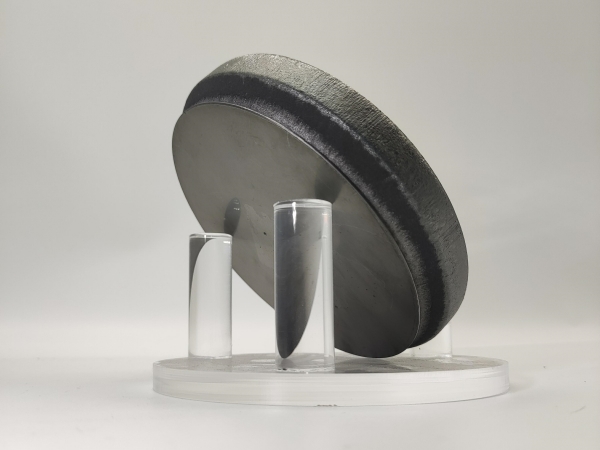
Single crystal diamond substrates are formed by carbon atoms in an sp³-hybridized tetrahedral structure, creating a perfectly ordered lattice without grain boundaries. This unique structure gives diamond extreme thermal, electrical, optical, and mechanical performance — making it widely regarded as the “ultimate semiconductor material.”
With ultra-high thermal conductivity and an ultra-wide bandgap, single crystal diamond is becoming a key enabling material in high-power semiconductors, RF devices, and advanced optical systems.

Thermal conductivity: 1000–2310 W/(m·K) (near theoretical limit)
5× higher than copper
4× higher than silicon carbide
Thermal expansion coefficient: 0.8 × 10⁻⁶/°C
Diamond maintains structural stability under extreme temperature cycling and effectively solves heat accumulation issues in high-power devices.
Bandgap: 5.47 eV
Breakdown field: 10 MV/cm
These properties far exceed silicon and SiC, enabling operation under high temperature, high voltage, and high frequency conditions.
Through boron doping, diamond becomes semiconducting (p-type), and boron–nitrogen co-doping can even induce superconductivity at low temperatures — opening opportunities in quantum electronics and next-generation power devices.
Transmission range: 225 nm (UV) to 25 μm (IR)
High refractive index: 2.417
Low optical loss (no grain boundary scattering)
Single crystal diamond is ideal for high-power laser systems, infrared optics, and radiation-resistant optical components.
Mohs hardness: 10
Extremely wear-resistant and chemically inert
Suitable for precision processing and harsh industrial environments
Single crystal diamond substrates are primarily produced by:
Mature and cost-effective
Limited crystal size (~20 mm)
Mainly used for industrial-grade and lower-end applications
CVD, particularly Microwave Plasma CVD (MPCVD), is the mainstream route for semiconductor- and optical-grade substrates.
Advantages:
Ultra-high purity (Type IIa)
12C enrichment up to 99.987%
2-inch substrates in pilot production
4-inch substrates under engineering validation
Surface roughness <0.5 nm after CMP polishing
Challenges:
Higher cost than HPHT
Yield and wafer bow control for large diameters
CVD technology is rapidly advancing toward larger wafer sizes and lower costs.
Diamond heat spreaders significantly reduce device junction temperature:
42% reduction in GaN HEMT junction temperature
3.6× longer device lifetime
Improved system efficiency
Applications include:
EV IGBT modules
PV inverters
Industrial power systems
GaN-on-diamond RF devices achieve 3× power density compared to SiC
Suitable for 5G base stations and satellite communications
NV center quantum sensors enable ultra-high-sensitivity magnetic detection
Diamond’s radiation resistance also supports aerospace semiconductor systems.
Diamond’s high thermal conductivity prevents thermal lensing and deformation in kW-level laser systems, making it ideal for:
Laser cutting
Welding
Additive manufacturing
Medical laser equipment
Diamond substrates are used for:
Infrared windows
Lenses
Prisms
They maintain optical stability under extreme temperature and radiation conditions.
Low defect density and high optical uniformity support:
Quantum communication systems
High-end spectroscopy
Advanced microscopy
The industry is moving toward:
Larger wafer sizes (4-inch and beyond)
Higher yield and lower cost CVD production
Integration into 5G, EVs, AI hardware, aerospace, and quantum technologies
Although challenges remain in large-diameter growth, defect control, and cost reduction, single crystal diamond substrates are transitioning from laboratory research to scalable industrial production.
With unmatched thermal conductivity, ultra-wide bandgap, and exceptional optical transparency, single crystal diamond substrates are positioned as a transformative material for next-generation semiconductors and advanced optical systems.
As manufacturing technologies mature and costs decline, diamond substrates will play an increasingly critical role in enabling high-performance, high-reliability electronic and photonic devices worldwide.
I. Core Industrial‑Application Value and Machining Bottlenecks of Silicon Carbide Subst...
I. Preface: Interfacial Thermal Resistance, the Invisible Bottleneck for Power Device He...
I. Preface: Heat Dissipation of High-Power Devices — The Core Industry Pain PointW...