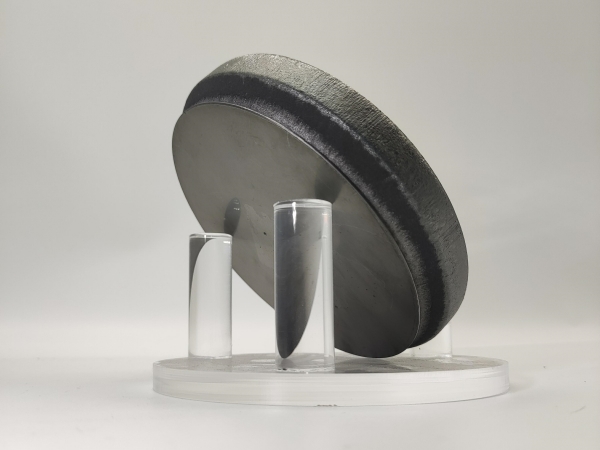
As a core material of the third-generation wide-bandgap semiconductors, Silicon Carbide (SiC) has become the key to breaking the bottleneck of silicon-based devices, thanks to its excellent properties such as high breakdown electric field, high saturated electron velocity, and high thermal conductivity. Silicon carbide epitaxy technology serves as the core bridge connecting SiC substrates and terminal devices, and its process maturity directly determines device performance. In recent years, with continuous technological breakthroughs, it has been driving power and RF devices towards high efficiency, miniaturization, and high frequency, empowering innovation in multiple fields.

I. Core Connotation and Basic Characteristics of Silicon Carbide Epitaxy Technology
Silicon carbide devices require the growth of a high-quality single-crystal thin film (epitaxial layer) on the substrate surface through epitaxy technology to eliminate substrate defects and release the material's advantages. Epitaxy is divided into homoepitaxy (growing a SiC layer on a conductive SiC substrate, suitable for low-power and RF devices) and heteroepitaxy (growing a GaN layer on a semi-insulating SiC substrate, used for high-power devices). The size, crystal quality, and uniformity of the epitaxial layer are the core indicators determining device performance.
At present, the mainstream specifications of epitaxial wafers cover 2-8 inches. Large-size epitaxial wafers are the key to cost reduction and efficiency improvement. The chip output per unit area of 12-inch epitaxial wafers can be increased by more than 3 times, and the comprehensive cost can be reduced by about 40%, making it the core direction of industry competition.
II. Main Growth Methods and Technological Evolution of Silicon Carbide Epitaxy
There are three mainstream methods for silicon carbide epitaxy: Chemical Vapor Deposition (CVD), Molecular Beam Epitaxy (MBE), and Physical Vapor Transport (PVT). The CVD method is the commercial mainstream, while the MBE and PVT methods form a complementary layout.
(1) Chemical Vapor Deposition (CVD) Method: Mainstream Commercial Technology with Continuous Process Optimization
The CVD method forms an epitaxial layer through the deposition of reaction gases on the substrate surface in a high-temperature reaction chamber (1500~1700℃). It has the advantages of strong controllability and few defects, and has been put into large-scale application. In recent years, through equipment upgrading and process optimization, the thickness non-uniformity of the epitaxial layer has been controlled within 3%, the doping uniformity is ≤8%, and the chip yield exceeds 96%.
Significant breakthroughs have been made in localization. At the end of 2025, Han Tian Tian Cheng launched the world's first 12-inch SiC epitaxial wafer, and Jingsheng Electromechanical delivered supporting epitaxial equipment, realizing a closed loop of "material-equipment-process".
(2) Molecular Beam Epitaxy (MBE) Method: Atomic-Level Precision Control, Suitable for High-End Devices
The MBE method achieves atomic-level precision growth in an ultra-high vacuum environment. The epitaxial layer has high quality and a flat interface, making it suitable for high-end RF and special power devices. In recent years, through temperature control optimization and the selection of high-purity raw materials, the dislocation density has been reduced to below 1×10⁵ cm⁻². The collaborative application with the CVD method can balance the high-frequency characteristics and voltage resistance of devices.
(3) Physical Vapor Transport (PVT) Method: High Growth Rate, Assisting Large-Size Epitaxy
The PVT method forms an epitaxial layer through the sublimation and deposition of raw materials. It has a high growth rate, making it suitable for the preparation of large-size epitaxial wafers. Its quality is slightly inferior to the previous two methods, and it is mainly used for mid-to-low-end devices. At present, stable growth of 8-inch and larger epitaxial wafers has been achieved, and the quality gap can be narrowed by combining with polishing technology.
Method.webp)
III. Core Breakthroughs in Silicon Carbide Epitaxy Technology: Triple Upgrades in Size, Quality and Cost
In recent years, silicon carbide epitaxy technology has shown a triple trend of "large size, high quality, and low cost". 2025-2026 has become a key breakthrough period, and the localization process has accelerated.
(1) Leapfrog Breakthrough in Large-Size Epitaxial Wafers, Gradual Improvement of Mass Production Capacity
China has achieved remarkable results in the field of large-size epitaxy. At the end of 2025, Han Tian Tian Cheng launched the 12-inch
SiC epitaxial wafer, and the 8-inch epitaxy technology has been maturely mass-produced; in March 2026, Tiancheng Semiconductor prepared a 14-inch SiC single crystal material, laying the foundation for larger-size epitaxial wafers.
(2) Continuous Optimization of Epitaxial Layer Quality, New Level of Defect Control
Through process optimization, the dislocation density of the epitaxial layer has been reduced from 5×10⁵ cm⁻² to below 1×10⁵ cm⁻², the thickness uniformity has been optimized to within 3% (some high-end products can reach below 2%), and the doping uniformity is controlled within ±5-10%, which significantly improves device reliability.
(3) Breakthroughs in Localized Technology and Equipment, Continuous Cost Reduction
China has realized the localized substitution of core epitaxial equipment and materials. The cost of domestic equipment is 30% lower than that of imported equipment, and high-purity silicon sources and carbon sources are independently supplied. The production capacity utilization rate has been improved through the integrated production model, and the unit area cost of epitaxial wafers has dropped to below 12 US dollars/cm², which is expected to drop by another 25% in the next 2-3 years.
IV. Technology Empowerment: Promoting the Innovation of Next-Generation Power and RF Devices
Silicon carbide epitaxy technology has broken the bottleneck of silicon-based devices, promoted the upgrading of power and RF devices, and is widely used in new energy, 5G/6G, aerospace and other fields.
(1) Empowering Power Devices: High Efficiency and Energy Saving, Adapting to High-End Scenarios
Power devices (MOSFET, IGBT, etc.) based on high-quality epitaxial layers have a critical breakdown electric field more than 10 times that of silicon-based devices, switch loss reduced by more than 70%, and excellent high-temperature stability. They can improve the cruising range of new energy vehicles and the efficiency of charging piles, and adapt to high-voltage and high-temperature scenarios. At present, they have been put into large-scale application, and the penetration rate is continuously increasing.
(2) Empowering RF Devices: High Frequency and High Speed, Supporting 5G/6G Evolution
GaN-on-SiC heteroepitaxy technology is the core solution for high-end RF devices. Combining the advantages of SiC and GaN, it achieves high power density and high-frequency characteristics, adapting to 5G/6G communication. It is widely used in 5G base stations, millimeter wave frequency bands, military radar, satellite communication and other fields, supporting the evolution of communication technology.
V. Existing Bottlenecks and Future Development Trends
At present, there are still bottlenecks: the quality of high-end epitaxial layers needs to be improved, and the batch stability of large-size epitaxy is insufficient; the cost is higher than that of silicon-based technology, and there are still technical barriers in high-end fields; the process compatibility is insufficient, and the P-type doping efficiency is low.
Future trends: 12-inch epitaxial wafers will enter large-scale mass production in 2026-2027, and 14-inch technology will gradually mature; the technical route will develop in a diversified way, and new methods will complement mainstream technologies; application scenarios will extend to AI data centers, AR glasses, etc.; the level of localization will continue to improve, and China will participate in global competition.
VI. Conclusion
Silicon carbide epitaxy technology is the core support of the third-generation semiconductor industry. At present, it has entered the critical stage from "technological breakthrough" to "large-scale popularization", empowering technological upgrading in multiple fields. In the future, with continuous process optimization and cost reduction, it will help China achieve independent controllability in the third-generation semiconductor field and promote the industry towards high efficiency, high frequency and green development.